
Same model. Same GPUs. Up to 54% more tokens per second.
We benchmarked the top miner patch for Qwen3.8-27B against the pinned baseline with NVIDIA's AIPerf. Output throughput rose 23 to 54% across every load we tested.
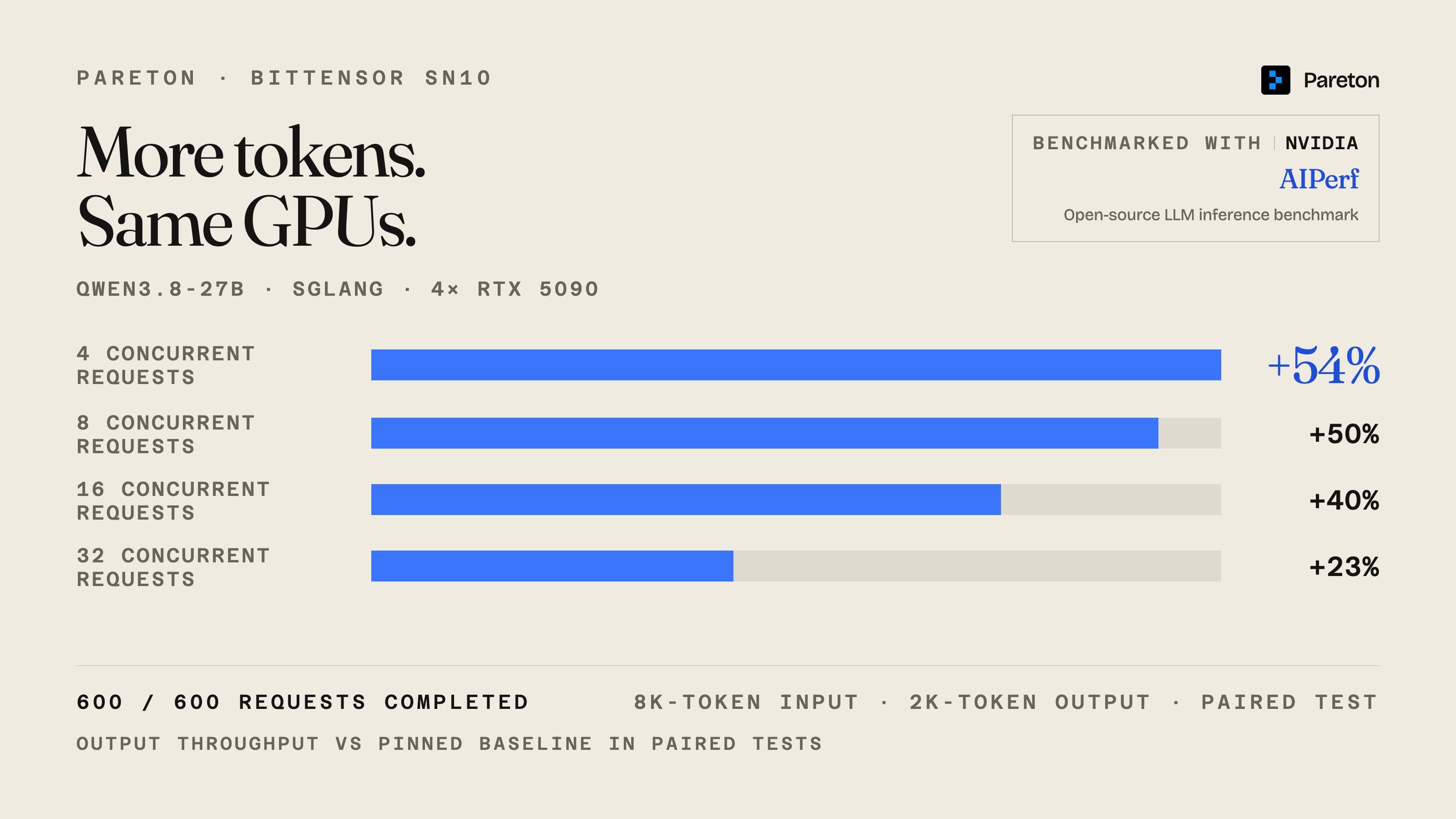
We took the top miner submission for Qwen3.8-27B and tested it against the pinned baseline using NVIDIA's AIPerf, an open-source benchmark for LLM inference. All 600 requests completed, and output throughput was 23 to 54% higher at every load we tested.
- Peak output throughput
- +54%
- Requests completed
- 600 / 600
- Lower GPU cost per token
- 19–35%
The setup
- Model
- Qwen3.8-27B
- Serving stack
- SGLang
- Hardware
- 4× RTX 5090
- Benchmark
- NVIDIA AIPerf
- Requests
- 8K-token input, 2K-token output
- Method
- Paired test against the pinned baseline
Paired means the patched engine and the baseline ran the same requests on the same machine, so the only thing that changed between the two runs was the miner's patch.
The results
| Concurrent requests | Throughput gain |
|---|---|
| 4 concurrent | +54% |
| 8 concurrent | +50% |
| 16 concurrent | +40% |
| 32 concurrent | +23% |
The gain is largest at low concurrency and narrows as the GPUs get busier. A likely reason: with only a few requests in flight the GPUs have more idle capacity, and that is where better kernels and scheduling recover the most. Even at 32 concurrent requests the patched engine still served almost a quarter more tokens on the same hardware.
Why it matters
Every token costs money. If the same four GPUs serve 23 to 54% more output, the GPU cost behind each token falls by roughly 19 to 35%, with no new hardware and no change to the model.
| Concurrent requests | Cost reduction |
|---|---|
| 4 concurrent | −35% |
| 8 concurrent | −33% |
| 16 concurrent | −29% |
| 32 concurrent | −19% |
That is the point of running this on Subnet 10. Miners compete to make the software that serves a model faster, and only changes that hold up against a pinned baseline get kept. The result here was not produced by one team over a quarter. It came out of an open competition, and the next round starts from it.
Every round and submission is public on the dashboard. The scoring rules are in the docs.