
Pareton joins Liquid Inference as a verified provider
Inference is turning into a market with live prices. On a market like that, cost per token is the whole game.
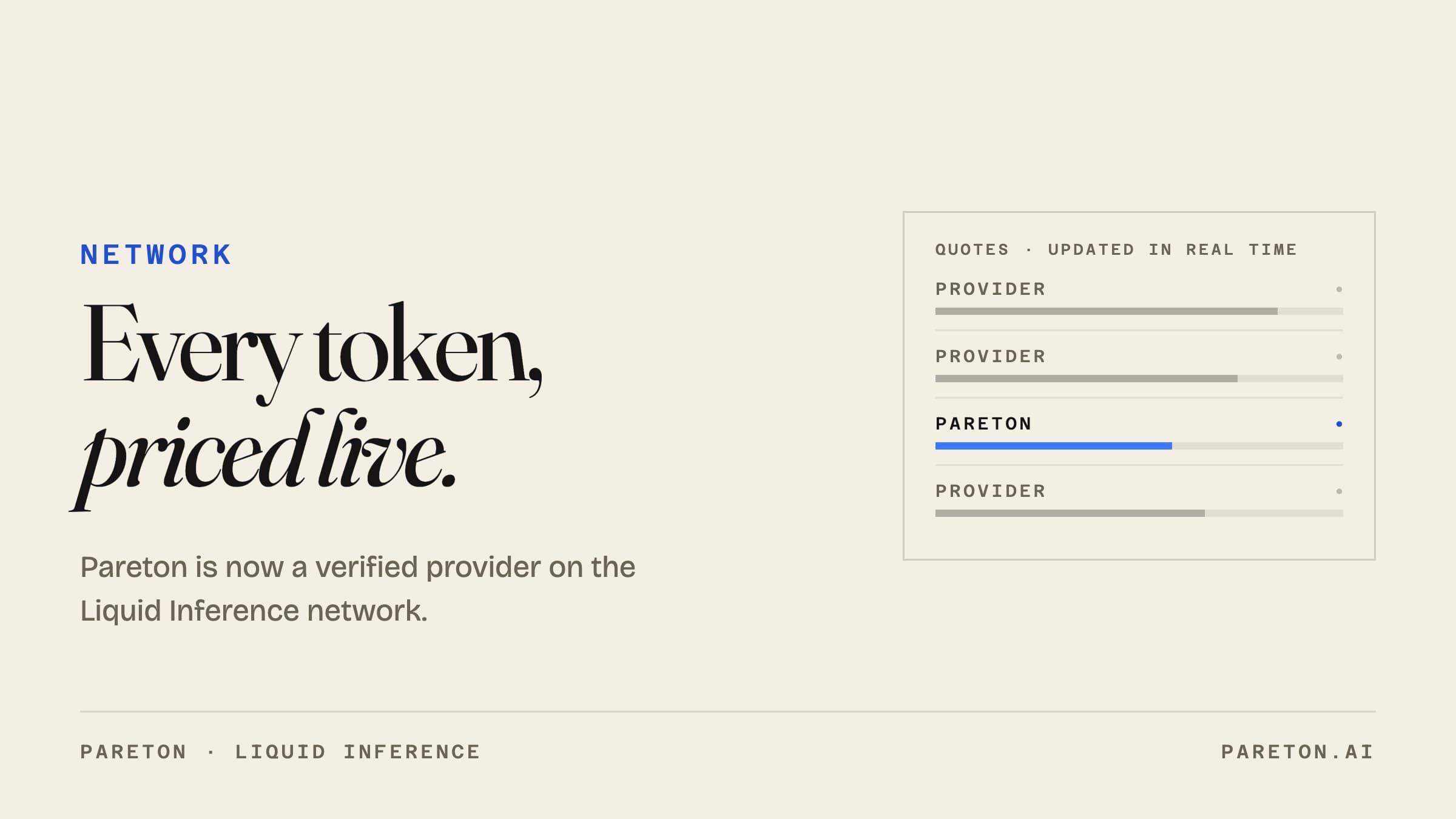
Pareton is now one of the verified providers on Liquid Inference, the router network built by Architect. Requests come in, providers quote for them, and the quotes move in real time. It is about as close as inference has come to a live market.
The network is growing fast. Architect's Brett Harrison put the count at 28 verified companies serving more than a thousand models, with providers onboarding and integrating a model in about three hours on average and clearing full verification within a day.
Inference is becoming a commodity
Many teams now serve the same open weights, often on the same GPUs. When the product on the shelf is identical, buyers compare on price and speed, and the market starts to look like any other commodity market: quotes, spreads, and continuous competition for every token.
Inference is rapidly becoming commoditized and financialized.
That is good for buyers. It is harder for providers, because the only lasting way to win a live market is to serve the same token for less, at the same latency, and keep doing it as the market moves.
Why this fits what we build
Cost per token is exactly what Pareton pushes down. Miners on Subnet 10 compete on the software that runs the model: kernels, KV-cache layout, batching, quantization, launch flags. A patch only survives if it serves more tokens on the same hardware under the same latency cap, and every win becomes the new baseline for the next round.
On a network with live pricing, that work shows up directly in the quote. A provider that serves up to 54% more tokens per second on the same GPUs can price more aggressively and still keep its margin.
What comes next
We see Liquid Inference as one more place where the gains from our campaigns turn into something a buyer can feel. More inference routed through open, competitive networks is good for everyone building them, Bittensor included.
If you run inference and want your cost per token to hold up in a market like this, get in touch.